Zerapy.ai
UI/UX Design
Contents
Overview
About Zerapy
Zerapy is an AI-powered clinical platform built specifically for physical therapy practices in the United States. It helps clinics manage patients remotely, automate the documentation that takes up half a therapist's day, and actually prove that therapy is working, with measurable outcomes that payors and patients can both see. The product was designed from the ground up around the workflows of real clinicians: the front desk staff overwhelmed by paperwork, the therapist squeezing notes between sessions, the clinic owner trying to figure out why RTM billing keeps falling through the cracks.
What We Solved
No Identity
Zerapy came to us with a working product and zero brand presence. The visual language was inconsistent, the color system was undefined, and the first impression it made didn't match the quality of what the software actually did. We built the identity from scratch.
Paperwork Overload
Physical therapists were spending up to 40% of their time on documentation, session notes, home exercise program updates, outcome tracking, insurance forms. None of it was connected. Zerapy's platform brought it all into one place with AI-assisted generation at every step.
Lost RTM Revenue
Most clinics had no idea they were eligible to bill for Remote Therapeutic Monitoring, or if they did, they couldn't keep up with the compliance requirements manually. Zerapy built RTM directly into the product so billing happens automatically, not as an afterthought.
What I Did
Brand Identity: Built the entire visual system from scratch, logomark, color palette, typography, iconography, and a full brand book used across product, marketing, and clinical collateral.
Patient Mobile App: Designed the iOS and Android app end-to-end: home exercise program, daily check-ins, outcome tracking, and HIPAA-compliant messaging for patient ages ranging from teens to post-surgical seniors.
Clinician Web App: Designed the full clinic-facing dashboard: patient management, exercise assignment via Pack Manager, AI-assisted documentation, and RTM compliance tracking.
Design System: Established a shared token and component library spanning mobile and web so the product could scale consistently as new features shipped.
Brand Identity
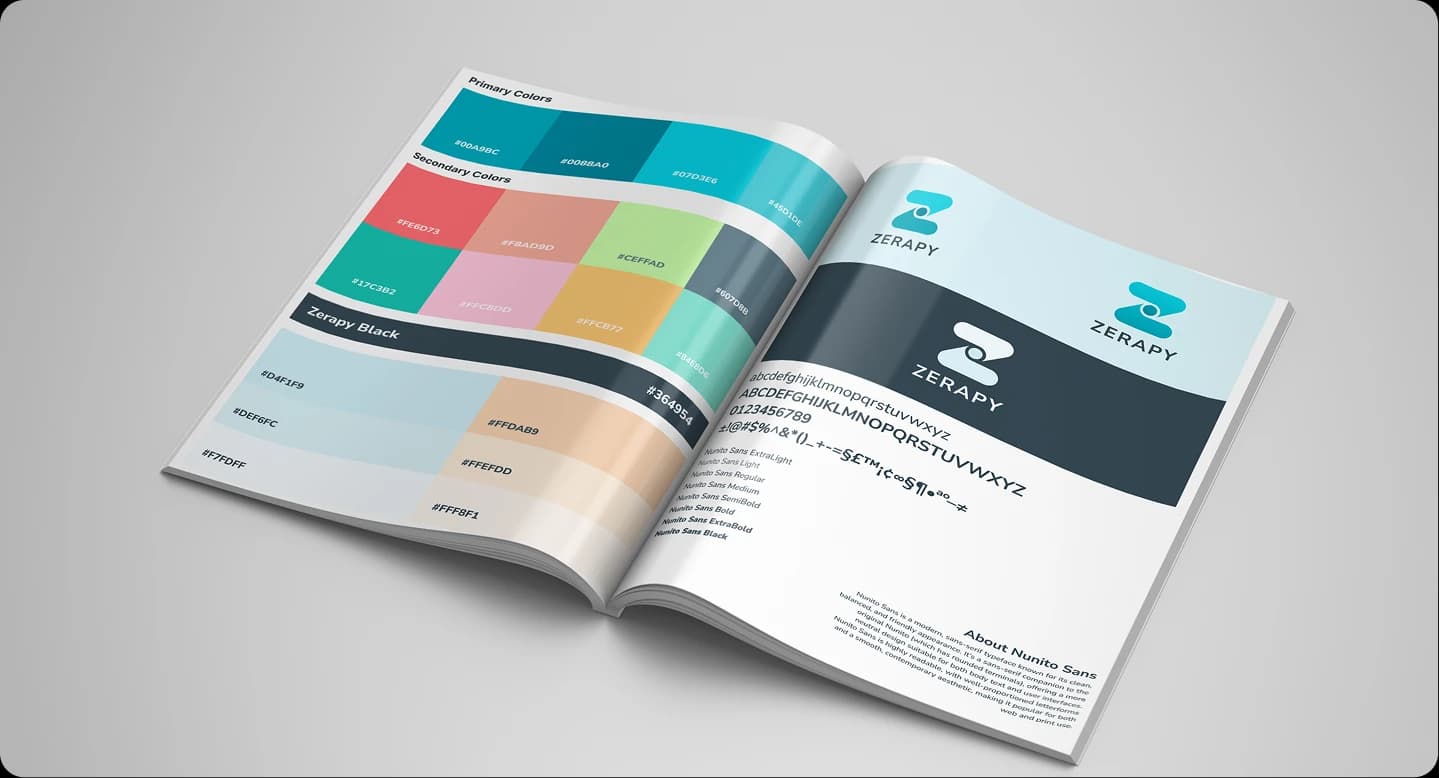
The brief was specific: look professional without feeling clinical. Healthcare brands have a tendency to default to sterile whites, cold blues, and stock photography of smiling doctors. Zerapy needed to feel trustworthy and credible, but warm enough that a patient would actually want to open the app, and modern enough that a clinic owner would be proud to show it to their staff.
The solution was teal on dark. A deep near-black background gives the brand weight and calm. The teal primary, drawn from the intersection of clinical green and tech blue, carries authority without aggression. Paired with a structured sans-serif wordmark and generous whitespace, the system reads as precise, modern, and human at the same time.
System Elements
Color: Teal (#14B8A6) as the primary action color against a near-black background (#0B1120). Secondary tones from the same hue family keep the palette cohesive across every context, from print collateral to the app's dark UI.
Typography: A geometric sans-serif for headings paired with a high-legibility text face for body copy. Both were chosen for readability at small sizes in clinical environments where screens are often viewed at a distance or in poor lighting.
Logomark: A custom mark that abstracts the idea of a therapeutic arc, motion, recovery, and measurement, into a single symbol that scales from app icon to large-format signage without losing clarity.
Iconography: A proprietary icon set that replaces generic medical clip-art with a consistent, purposeful visual language. Every icon in the product and marketing materials follows the same stroke weight, corner radius, and optical balance.
Mobile App
Patient-Facing iOS & Android
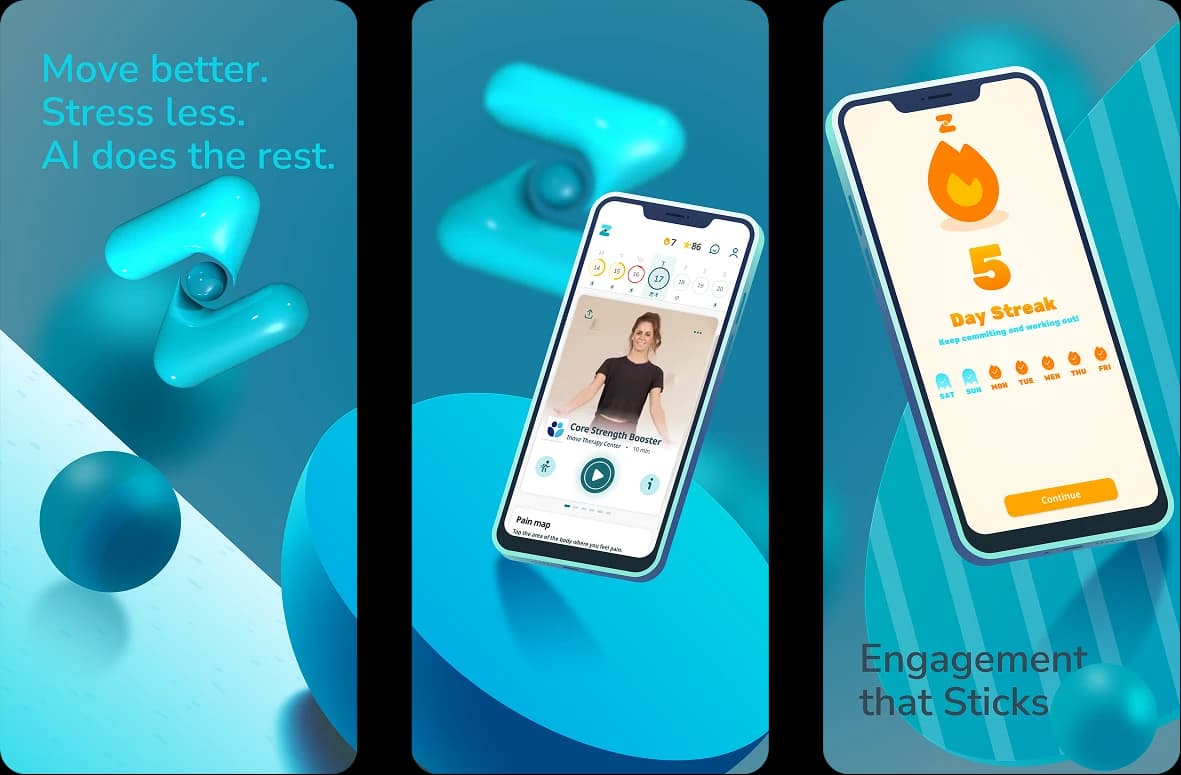
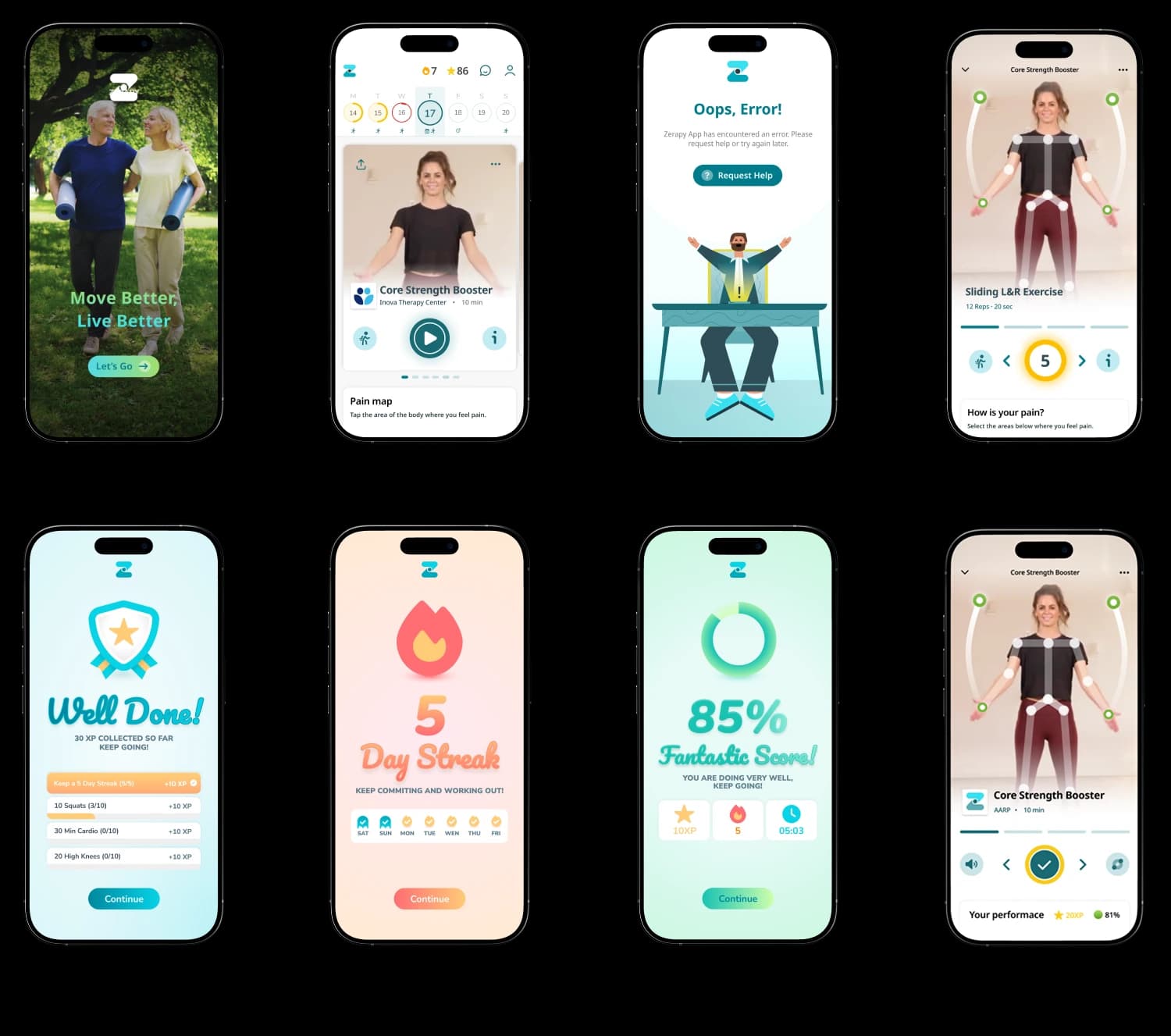
The patient app is the front door to the entire Zerapy ecosystem. When a clinic onboards a patient, that patient receives an invitation to download the app, from there, everything their therapist assigns them lives in one place: their home exercise program, their scheduled check-ins, their outcome questionnaires, and their progress over time. The design challenge was making it genuinely usable for patients who range from 18-year-old athletes to 72-year-old post-surgical recovery cases.
Core Patient Flows
Home Exercise Program
Patients receive their full HEP with video demonstrations, rep/set targets, and difficulty progressions, all assigned directly by their therapist in the web app. Completion is tracked automatically and synced back to the clinic's dashboard in real time.
Daily Check-Ins
Brief push-prompted daily questionnaires, pain level, function, mood, that take under 30 seconds to complete. Each response contributes to the patient's outcome score and, critically, counts as an RTM-qualifying data collection day.
Outcome Tracking
Validated clinical scales (PSFS, NPRS, GROC, OPTIMAL, DASH, LEFS) presented in plain language so patients understand what they're measuring. Progress is visualized as a trend chart, giving patients a sense of momentum even on hard days.
Messaging
HIPAA-compliant asynchronous messaging between patient and therapist. No third-party apps, no missing context. Every message is logged, timestamped, and attached to the patient's record, which also counts toward RTM interactive communication requirements.
Web App
Clinic-Facing Dashboard
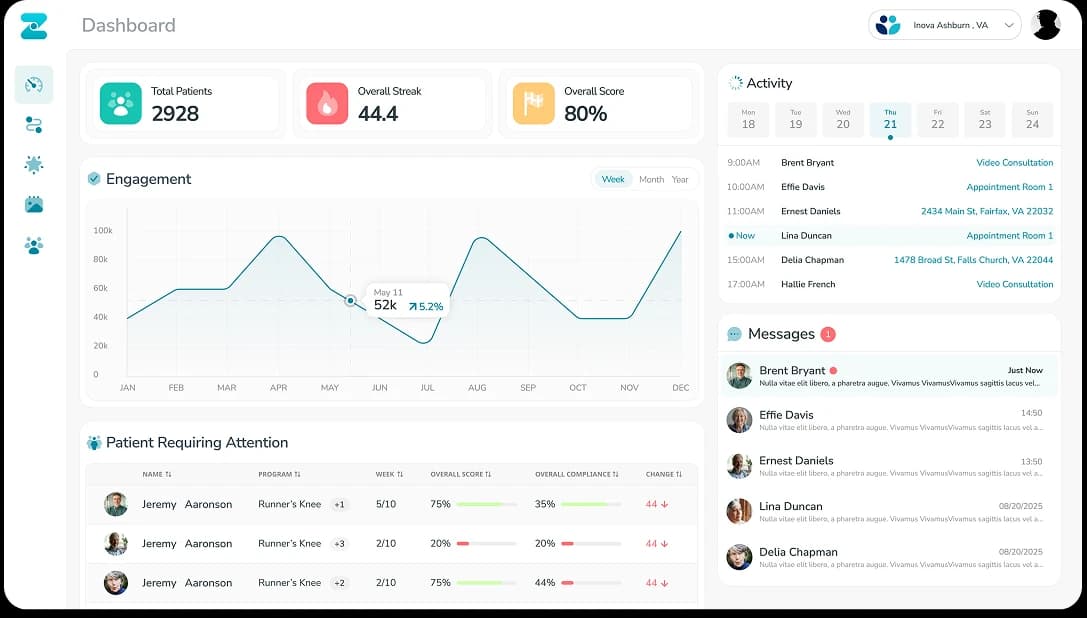
The web application is where the clinical work happens. Therapists manage their entire caseload from a single screen: assign exercises, review patient responses, send messages, generate notes, and track RTM compliance, all without switching tools or copying data between systems.
The Command Center
Designed to be simple and uncluttered. Only the essentials a therapist needs every day: total patients, overall streak and score, engagement trends, upcoming schedule, messages, and patients requiring immediate attention.
Remote Therapeutic Monitoring
RTM is the single biggest untapped revenue opportunity in physical therapy right now, and most clinics are leaving it entirely on the table. When CMS introduced the RTM billing codes in 2022, they created a reimbursement pathway for therapists to get paid for the work they were already doing: checking in on patients between sessions, reviewing home exercise adherence, responding to messages. The problem is that claiming RTM requires strict documentation compliance, and doing that manually is worse than not doing it at all.
Zerapy was built around RTM from the beginning. Not as a feature bolted on later, as the underlying reason the product exists. Every interaction in the patient app that qualifies as an RTM data collection day is tracked automatically. Every therapist-patient message that counts as an interactive communication session is logged with a timestamp. The billing window, the day count, the threshold warnings, all of it is handled by the platform so the clinic's staff can stay focused on clinical care.
RTM Billing Codes
How Zerapy Automates RTM
Automatic Day Counting
Every time a patient logs a check-in, completes an HEP session, or records a symptom entry through the app, Zerapy marks that as a qualifying RTM data collection day. The counter is visible to both the therapist and the front desk in real time, no spreadsheet, no manual tally.
Compliance Alerts
If a patient is at 10 days with only 8 days left in their billing window, the system flags it automatically. The therapist gets a nudge to prompt the patient. The front desk sees a risk indicator on the patient's row. Nobody misses a billing period because they forgot to check.
Interactive Communication Logging
Every message thread, every video check-in, every phone note logged through the system is tagged as an interactive communication event. The billing report at the end of the period pulls these automatically, with timestamps, duration, and the therapist's name already filled in.
One-Click Billing Reports
When the 30-day window closes, the clinic can generate a complete RTM billing report for every eligible patient in under 30 seconds. The report is pre-formatted for submission, with the correct CPT codes, patient IDs, qualifying day counts, and communication logs already compiled.
The Revenue Math
A clinic with 50 active RTM patients billing a conservative combination of 98977 + 98980 every 30 days is looking at roughly $45,000–$60,000 in additional annual revenue, with zero additional clinical hours. The documentation already existed. The patient interactions were already happening. Zerapy connects the dots so the clinic actually captures what they've already earned.
The bigger shift is behavioral. Once a clinic sees their RTM dashboard working, day counts ticking up, alerts firing before windows close, billing reports generating themselves, they stop thinking of remote monitoring as a compliance burden and start treating it as a core service line. That changes how they onboard patients, how they structure their HEP assignments, and how they communicate between sessions. The platform makes better habits feel effortless.
Website
Digital Storefront for the American Market
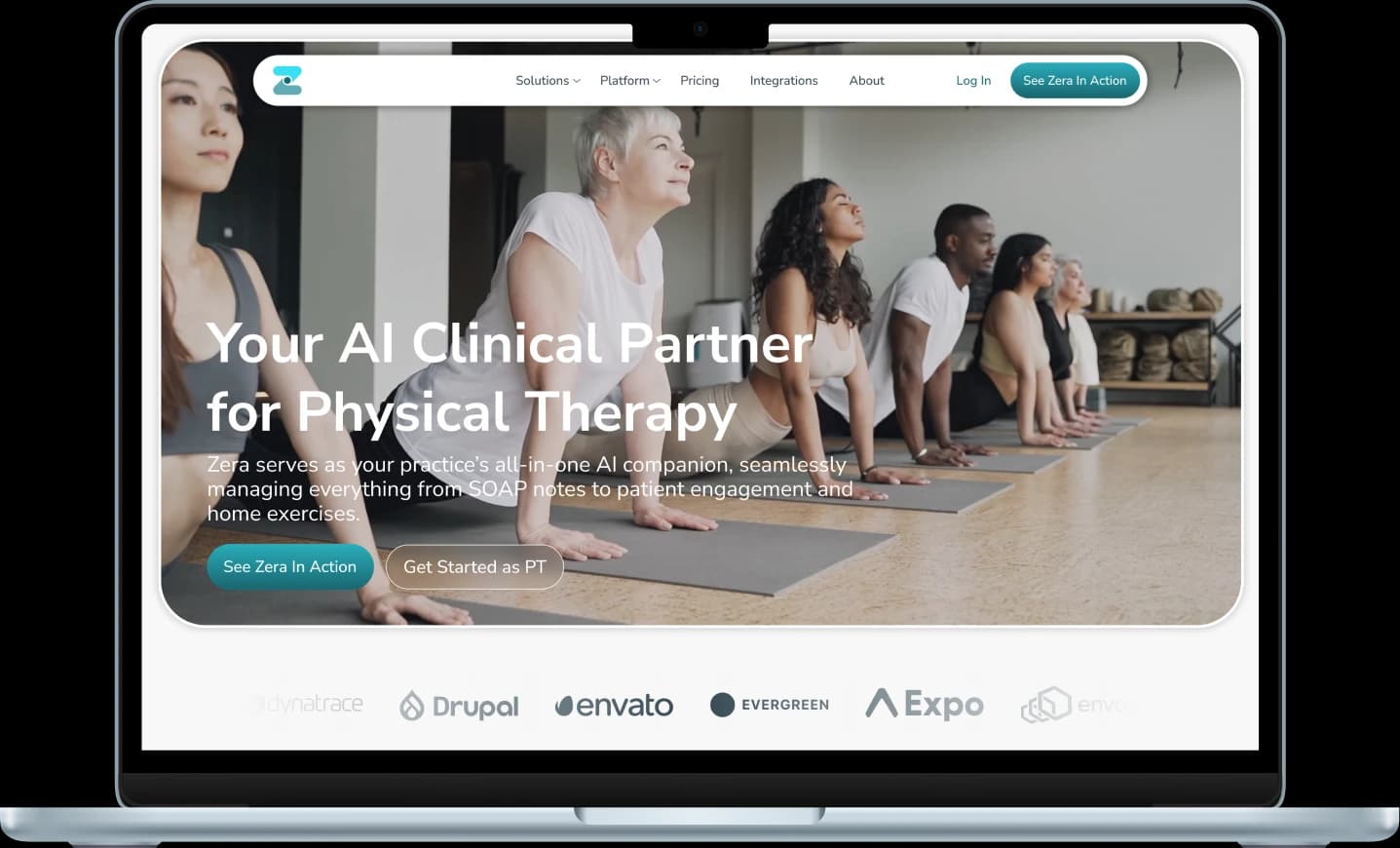
The Zerapy website had to do real work. Not just exist, convert. The target audience is a PT clinic owner or practice manager who has roughly 90 seconds before their next patient arrives. They landed on the site from a LinkedIn post or a Google search. They need to understand what Zerapy does, why it matters for their practice, and whether it's worth scheduling a demo. That decision happens above the fold.
The homepage opens with the RTM angle front and center, not as a feature, but as a statement of lost revenue. The number is specific and uncomfortable in the right way. Below it, the product shows itself: actual interface screenshots, actual workflow steps, actual outcomes from early clinic partners. Social proof from clinicians, not investors. Pricing that's visible without a sales call.
The site is built on Next.js with a focus on Core Web Vitals, because slow healthcare sites lose trust before a visitor reads a single word. Accessibility was treated as a first-class requirement, not an afterthought. WCAG 2.1 AA compliance throughout, with contrast ratios that hold up even on older clinical monitors.
Workers' Compensation Video
From Paperwork Chaos to One-Click Calm
The video brief was specific: Workers' Compensation. It's one of the most paperwork-intensive billing contexts in physical therapy, multiple payors, strict documentation requirements, case managers who want regular updates, attorneys who need functional outcome reports. Clinics that treat workers' comp patients are often drowning in forms.
The spot opens in the chaos: a front desk overflowing with paper, a therapist typing at 11pm, a phone ringing with a case manager on the line. No voiceover. Just the ambient noise of a practice that's barely keeping up. Then one click. The interface appears. The forms are already filled. The outcome report generates itself. The phone stops ringing, because the case manager already has what they need.
Concept, storyboard, character design, animation, all built in-house. The visual style carries the Zerapy brand into motion: teal accents on dark backgrounds, clean transitions, moments of stillness that let the relief land. The video ran as a paid social spot targeting clinic owners and office managers in workers' comp-heavy markets across the US.
Concept
Before/after, the contrast between the administrative chaos of workers' comp billing and the calm that Zerapy creates. Emotional before intellectual. The viewer feels the problem before they understand the solution.
Production
Full in-house production: storyboard, character design, environment illustration, motion design, sound design, and final delivery in multiple aspect ratios for social, web, and presentation use. No external vendors.
Distribution
Paid social campaigns targeting LinkedIn and Meta, aimed at PT clinic owners and practice managers in workers' comp-heavy states: California, Texas, Florida, and New York. A/B tested against a more feature-forward variant.
By the Numbers
Live Product
 Google Play
What Came Next
The first project opened a door. The brand gave Zerapy something to stand behind. The product design gave clinicians something they actually wanted to use. The pitch deck helped them tell a story that investors and partners could follow. And the RTM system gave clinics a concrete reason to switch that paid for itself in the first billing cycle.
The ongoing engagement moved from launch to growth: feature expansion, onboarding optimization, a referral program for clinic networks, and marketing assets for the enterprise sales motion. The relationship continues because the work continues to compound.
Brand: A full visual identity that reads professional without feeling clinical. Teal on dark. Modern, trustworthy, and scalable across every context from mobile app to pitch deck to print collateral.
Product: A mobile app patients actually complete their HEP on, and a web dashboard therapists actually prefer over their EMR for daily patient management. Interfaces that doctors get without a manual and patients use without thinking.
RTM: An automated RTM compliance engine that tracks data collection days, flags at-risk billing windows, logs interactive communication sessions, and generates billing-ready reports, turning a missed revenue stream into a reliable income line.
Revenue Impact: Early clinic partners reported capturing RTM revenue within the first 30 days of using the platform, in most cases more than enough to cover the annual subscription cost before the first month ended.